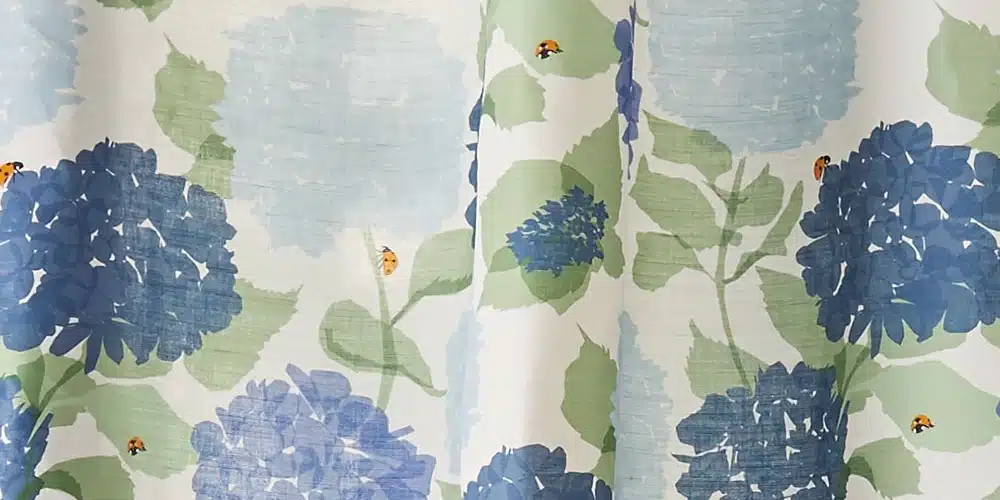
Have you ever looked at a hydrangea in full bloom and thought, that would make a beautiful fabric? That is exactly the starting point for this case study, which follows one hydrangea motif from a garden bloom to a finished surface pattern. You will see how Lorna Syson Designs takes a single idea through drawing, repeat construction, colourways and scaling, then carries it across designer fabrics, wallpapers, homeware, greetings cards and wrapping paper. Along the way, we will look at why a hydrangea became a Lorna Syson Designs motif, how the repeat is built, and how one pattern can feel at home on a curtain, a wallpaper roll or a card. This is written for beginners, so no prior design knowledge is needed. By the end, you will understand how Lorna Syson Designs helps trade buyers and homeowners see the same pattern in different formats, and why a well-built surface design earns its place by working across many products.
Why a Hydrangea Became a Lorna Syson Design
I keep a sketchbook close to the garden door, and hydrangeas found their way into it because of their shape. Rounded flower heads, layered petals, and a colour that shifts from soft blue through to pink (Hydrangea macrophylla). That shift makes the bloom a natural candidate for a repeat, since one plant offers several colourways before a pencil has even touched the page.
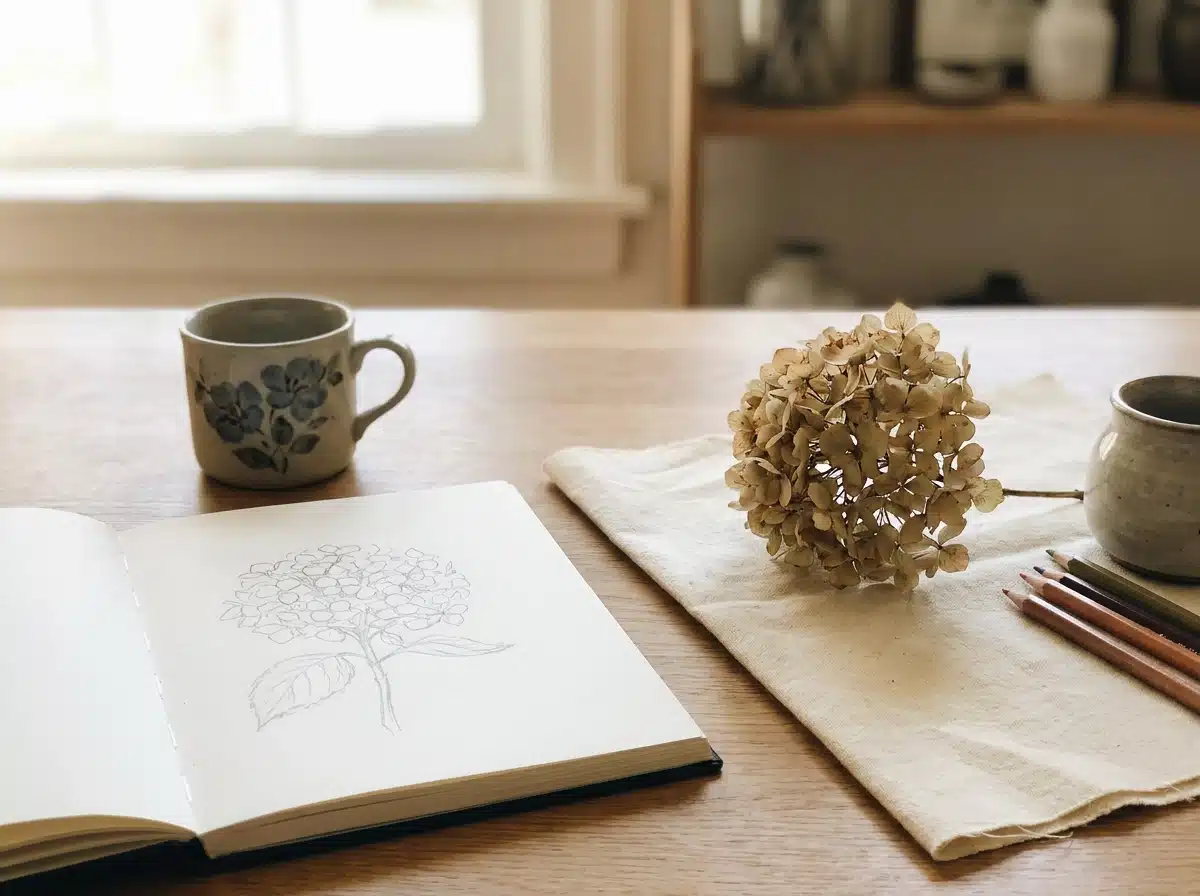
The garden feeds the sketchbook directly. I draw from the plant in front of me, not a photograph, so the motif keeps the small irregularities that make it feel alive: a lopsided head, a gap where a petal has dropped, leaves that are not quite symmetrical.
Hydrangeas suit surface pattern too. Their bold silhouette, strongly repeating petal structure and clean leaf shapes stay readable at any scale, whether scaled down for a greetings card or blown up across a wall.
This flower sits within a wider family of Lorna Syson Designs floral, bird and wildlife artwork rather than standing alone, and the same drawing instincts carry across all of it. That thinking is already visible in the Lorna Syson Designs wallpaper collection.
From here I will walk through the journey: the first sketch, the repeat, the colourways, then the formats the finished design lives on, from fabric and wallpaper to homeware, greetings cards and wrapping paper.
From Garden Bloom to Drawing
The first drawings are deliberately loose. I sketch the whole head in pencil, chasing the overall silhouette long before I worry about individual florets, because a hydrangea is really two flowers in one: a ring of showy blooms around a denser centre. That structure decides how the shape reads at a glance, and whether I follow a rounded mophead or a flatter lacecap silhouette.
Then the editing starts. A real head is dense with tiny florets, so I reduce them to a readable version, keeping the character and cutting the noise. Stronger outer petals carry the eye, softer interior marks add depth without competing, and leaves are drawn to sit beside one another so they leave no odd gaps or heavy clumps when they meet.
Then I test it small. If a motif will appear on a greetings card or a sheet of wrapping paper, it has to read clearly at a few centimetres before it is scaled up for a wall.
The finish gets decided early too. A hand drawn look and a cleaner digital finish behave very differently once artwork becomes a repeat and is printed onto fabric or paper, so that choice shapes the drawing itself. It is the same discipline behind a book commission, where the art has to hold up across pages and print.
Next, how that drawing becomes a repeat.
Building the Repeat
With a clear drawing in hand, the next job is the repeat.
A repeat is one tile of artwork that joins back onto itself, so a wall or a roll of fabric prints as a continuous pattern rather than a single picture. That is the plain answer to what is a wallpaper pattern repeat, and it is the stage where a promising drawing either holds together or falls apart.
Straight: motifs line up in rows, giving a neat, orderly rhythm. Half drop: each row drops by half a tile, so joins hide and the pattern feels more natural. Brick: rows offset like brickwork, adding a livelier, staggered movement across a curtain or wall. For my hydrangea, a half drop keeps those rounded heads from lining up like soldiers.
Then come the checks. Line up the tile edges, match motif joins by eye, and look for accidental stripes or dense patches that appear only once the tile repeats. These faults are invisible in a single tile and glaring across a few metres.
Scale rewrites the repeat. A tight repeat suits cushion panels and greetings cards, where the motif needs to appear often. A larger repeat gives wallpaper and curtaining a calmer, more spacious feel.
For curtain makers and interior designers, a clean repeat is practical, not decorative: reliable joins mean easier cutting, fewer awkward seams and less wasted fabric. Get the repeat right and the next decision is colour.
Colourways and Scaling
Once the repeat holds together, colour and scale decide how that pattern behaves on a real wall, a real curtain, a real cushion.
Colourways start with the plant itself. A hydrangea offers a natural range of soft blues, pinks and deeper, duskier tones, so I pull a small palette straight from that range. Nothing gets redrawn. Changing the palette alone lets the same hydrangea sit quietly in a calm bedroom or hold its own in a bolder living space.
Ground colour is chosen alongside the flowers, never afterwards. The background changes how vivid a motif reads, because colour appearance depends on the colours around it. Put the same bloom on a busy, high-contrast ground and it flattens. On a softer one it gains depth and the petals lift. No formula predicts that perfectly, so palettes get tested rather than assumed.
Scaling is testing too. I print the artwork at wallpaper scale, at fabric scale and at card scale, then look for where the motif still reads clearly and where it turns to mush. Detail that sings across a wall can vanish on a smaller object, which is exactly the lesson behind the illustrated ceramic candles.
With the palette settled and the scale checked, let’s look at where this hydrangea actually lives.
One Pattern Across Fabric and Wallpaper
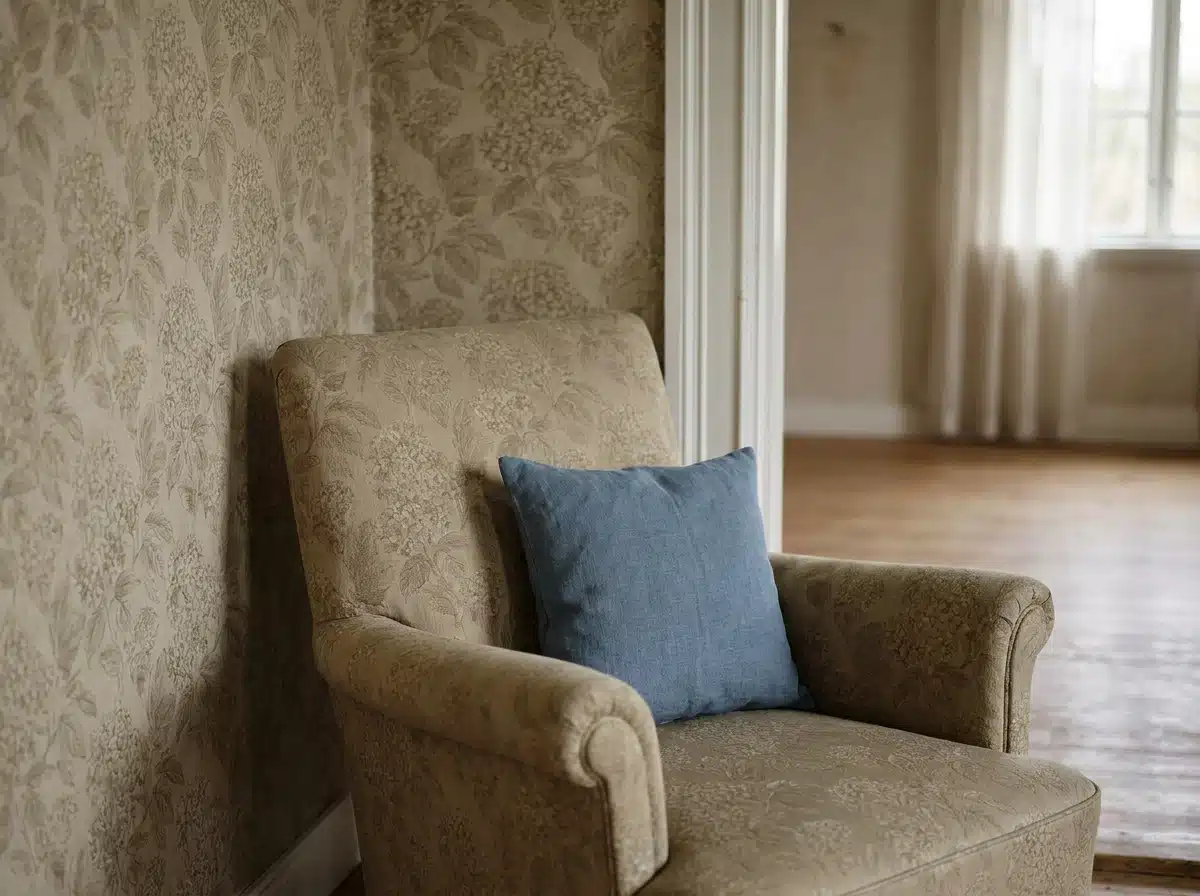
Get the scale right, and the hydrangea is ready for cloth.
On fabric, it works across curtains, blinds, upholstery and soft furnishings, though the repeat behaves differently in each. On a curtain the pattern stretches and softens as the cloth drapes, so a medium repeat tends to feel fuller and more generous. A blind hangs flat, so the repeat reads closer to how it looks on paper. Upholstery takes far more wear, so the motif needs to hold up at close quarters.
The same artwork suits wallpaper just as well. In a full room it creates a continuous garden; on a single feature wall it directs the eye; in a small cloakroom the larger scale can feel like a treat rather than a squeeze.
That is the quiet advantage of one motif in both: curtains and walls coordinate from the same drawing instead of being matched by eye across two different patterns.
If you specify fabric or wallpaper for a living, the practical details matter most. Clear repeat information, a usable scale, and enough length for larger projects are what let you plan a room confidently. Lorna Syson Designs sets out the fabric and wallpaper ranges on lornasyson.co.uk, and there is more on bespoke fabric designs that match fabric to wallpaper.
Next, the same repeat travels onto smaller things.
Homeware, Greetings Cards and Wrapping Paper
Fabric and wallpaper give the hydrangea room to stretch. Smaller formats ask the same drawing to hold together when it is squeezed.
Homeware tightens the scale most. The candle range wraps the repeat around a curve no wider than your hand, so petals must stay legible at just a few centimetres across. A pattern that turns to mush there was never really built to travel.
Greetings cards push the design down further. Personalised greetings cards are available, and a simple crop usually beats the full repeat: a few florets and a leaf read instantly, while the whole tile just looks busy.
Wrapping paper flips the problem entirely. It gives the hydrangea its biggest canvas, so the repeat can breathe, edge spacing opens up and the petal detail finally shows.
Planners, along with the wider floral, bird and pet illustrations, run on exactly the same thinking applied to different subjects. That shared approach is why a hydrangea sits comfortably in the range rather than looking like a guest.
All of it loops back to the drawing board. That early discipline — edge spacing, contrast, motif size — pays off at every scale. That is what makes one motif genuinely useful across a whole range, and it is the same discipline behind every design here. Next, it is worth seeing what that consistency means when you are buying rather than drawing.
What This Means for Trade Buyers and Homeowners
So once the hydrangea has travelled from a card to a candle, what does that mean if you are buying for a project or a shop? Quite a lot, because the hard work is already done at the design stage.
For interior designers and curtain makers, one design that covers fabric, wallpaper and finishing touches means fewer decisions per project. You can build a coordinated look without matching separate patterns by eye.
For homeware retailers, the same motif can be merchandised as a story across several products, rather than a scatter of unrelated patterns on a shelf.
For homeowners, you can buy one design once and live with it in different rooms. A new colourway or a different format refreshes the scheme without starting again.
If you are an interior designer, curtain maker or homeware retailer, you can enquire about trade terms and stock directly through lornasyson.co.uk. It is worth reading about what a trade fabric and wallpaper account involves before you ask, so you know what to compare.
And if you would like to follow along, sign up to the Lorna Syson Designs newsletter on the site for the latest news and offers.
A Good Surface Design Earns Its Place Across Formats
That same one pattern, many formats approach is why a surface design has to be built properly before it reaches a product. For the fuller background to Lorna Syson Designs, the studio profile is a good next read.
Conclusion
A hydrangea can travel beautifully from garden bloom to drawing, repeat, colourway and product when the design is built with care. This is how one pattern earns its place across many formats. Let one thoughtful pattern bring a garden’s calm into more parts of daily life.